

L'INDE SUIT LA RUSSIE
L'INDE SE PREPARE A RENFORCER LES POUVOIRS DU Central Bureau of Investigation DANS LA LUTTE CONTRE LE BRACONNAGE DES TIGRES (Source: Times of India du 27 mars) et va donc dans le sens de la Russie (voir "Département spécial" sur ce blog le 26 mars).
NAGPUR: The Central Bureau of Investigation (CBI), which has a strong wildlife squad as part of the economic offences wing, may now play a pivotal role in countering poaching cases related to tiger. As part of futuristic policy, CBI may start the initiative with a two-day seminar on saving tiger at Nagpur which is considered as a 'gateway to the tiger capital' following TOI's special effort. Rishi Raj Singh, joint director of CBI's newly formed Bhopal region, told a media conference at CGO...


LUCIDITE
Devant les risques de conflit dans la nouvelle réserve à tigres de Sathyamangalam en Inde du Sud ouest (voir "The Hindu" de ce jour), le Professeur Raman Sukumar montre le caractère contre productif de l'arbitraire politico - administratif et promeut le partenariat.
Unauthorised temples, new resorts and makeshift shops inside the core area are major threats the newly formed Sathyamangalam Tiger Reserve is facing.
The State government announced the formation of the fourth tiger reserve in the State through a notification, issued on March 15 this year.
Members of the Tamil Nadu Green Movement pointed out that several unauthorised places of worship were found inside the tiger reserve. There are three main temples – Karuvannayan temple near Nandhipuram, Bannariamman temple Bannari and Madeswara temple in Kongalli. The three temples are under the control of Hindu Religious and Charitable Endowment Board. Apart from them, several unauthorised temples are found inside the core area, say the members.
People visiting these temples camp there, even cook, and travel in large numbers into the core areas in trucks. Their movement creates a lot of disturbance to the wildlife. The State government must immediately relocate the unauthorised temples from the core areas, the members pointed out.
Another important issue is the springing up of new resorts in the core areas. S. Jayachandran of the Tamil Nadu Green Movement said Kongalli, Mavallam, Araiya Palayam and Hasanur are the places where the resorts are coming up. There were more than 200 resorts inside the STR.
Man-animal conflict
In the long run, it will lead to man-animal conflict, he said. The department officials have to immediately promulgate the ecologically sensitive zone to stop any more resorts in the core areas, he said.
Environmentalists also pointed out that during festival season, people set up shops, stay in the forests and defecate in the core tiger reserve area. Temporary shops have come up right on the elephant corridors located between Susilkuttail and Bannari. The Forest department authorities have to intervene and take action under the Forest Conservation Act of 1980, the activists said.
‘Make them partners’
Raman Sukumar, Professor and Chairman, Centre for Ecological Sciences, Indian Institute of Sciences, who began his research on elephants in the early 1980s, said the tiger population had increased substantially in the Sathyamangalam area. A good number of settlements over a century old were in Hasanur, Talamalai, Geddasal, Chikkahalli, Neydalapuram and Kadambur, to name a few. People in these settlements co-existed with the tigers over time. These people should be made partners in the management of the tiger reserve.
BREVE INCURSION
LE TIGRE RUSSE QUI AVAIT PENETRE EN TERRITOIRE CHINOIS LE 8 MARS A REFRANCHI LA FRONTIERE EN SENS INVERSE. Source : China Daily, ce jour.
A wild Siberian tiger from Russia has finished his brief vacation in Northeastern China and returned home, according to local forestry authorities.
The tiger first crossed the Wusuli River, or Ussuri River which borders China and Russia on March 8, according to Russian authorities who sought help from China to find the animal after losing contact with its GPS collar.
The Dongfanghong Forestry Bureau in Heilongjiang province organized a 50-member search team and was able to track the tiger while issuing warnings to adjacent villages.
After more than ten days of tracking the big cat, the bureau said on Tuesday that the tiger had returned to Russia.
"We followed it to the side of the (Wusuli) river where its paw prints were pretty clear," said Yang Lijuan, an official with the bureau. "So we sort of saw it off to Russia," She added.
It is rare for wild Siberian tigers, one of the world's top 10 endangered species and are primarily inhabiting the Sikhote Alin mountain region in Russia, to cross the country's border, especially in recent years, said experts.
GLOOMY SWAMPS
RECENSEMENT 2013 - 2015 : LES TIGRES DES MARAIS POURRAIENT BIEN ÊTRE MOITIE MOINS NOMBREUX QU'ESTIMES EN 2004. Source : Bangkok Post, hier.
Pendant ce temps, en Inde du Sud, une nouvelle réserve à tigres devrait ouvrir prochainement près du Parc Corbett (Hindustan Times : hier).
Bangladesh is to launch a census of tigers next month living in the world's largest mangrove forest in a bid to determine the full extent of the threat to their survival, scientists said on Tuesday.

An Indian Royal Bengal tiger pictured at the Nehru Zoological Park in Hyderabad, southern India, on June 5, 2010.
Bangladesh is to launch a census of tigers next month living in the world's largest mangrove forest in a bid to determine the full extent of the threat to their survival, scientists said on Tuesday.
Yunus Ali, head of the forestry department, said conservationists would fan out across the Bangladeshi side of the Sundarbans to install cameras on trees to obtain a more accurate estimate of tiger numbers since the last census in 2004.
That survey estimated that 440 Royal Bengal Tigers were on the Bangladeshi side. The forest, which includes parts of India's West Bengal state, spans a total of 10,000 square kilometres (3,860 square miles).
But some experts have criticised the methodology used last time around, which relied on the tracking of footprints and, together with a real decline blamed on poachers, believe the current figure could be less than half that amount.
The Bangladeshi scientists will be assisted by wildlife experts from the US-based Smithsonian Conservation and Biology Institute, Ali told AFP Tuesday.
Scientists hope the cameras will help them compile a more accurate figure over the next two years.
"The pugmark (tracking) system created controversies. It's not reliable," Ali said, adding that the new survey should "end all the debate".
Monirul Khan, a zoology professor at Bangladesh's Jahangirnagar University and the nation's foremost tiger expert, expected the survey to confirm his fears that there were no more than 200 tigers on the Bangladeshi side.
"Camera trapping is a far better and more widely accepted technique. If it is done scientifically, it can give an accurate result," he said.
Khan said that around five tigers were killed every year either by villagers trying to protect themselves or by poachers who then sell on their skins or even body parts which are prized in Asia as an aphrodisiac.
There are around 1,850 Bengal tigers living in the wild, according to the WWF conservation group, including around 1,300 tigers in India.
A census on the Indian side of the Sundarbans, conducted between 2003-04 put the numbers at around 270, although some experts say the real figure is actually less than 100.
A similar survey is currently under way in the Tarai Arc Landscape, a forest region which straddles Nepal and India.
There may soon be another option to spot tigers in the hills of Uttarkhand - Rajaji National Park - in addition to extremely popular big cat destination, the Corbett National Park.
The Uttarakhand Forest Department has decided to ask the National Tiger Conservation Authority (NTCA) to declare Rajaji National Park as a tiger reserve.
The Dehradun based Wildlife Institute of India has caught around 30 tigers on camera in Rajaji in the last few years making the state forest department believe that the landscape could become a substitute tiger home if right protection measures are enforced.
Rajaji has got most of its tigers from nearby Corbett, who move out to nearby forest areas because of high density of big cats. Unlike other big animals, tiger are solitary in nature and carve out their own territory by pushing out physically weaker tigers. As a result many tigers move out to adjoining forest areas such as Rajaji which may not have protection of the Corbett standard.
That problem can be sorted out if Rajaji is declared as a tiger reserve.
The NTCA provides special funding to tiger reserves to combat poaching and provide inviolate (disturbance free) core tiger area to foster breeding tiger population. The authority gives Rs. 10 lakh for relocation of every family living inside a tiger reserve.
State government officials said that around 500 families are living inside Rajaji, which are a constant threat to tigers there. About a month ago a tiger in Rajaji national park was allegedly poisoned by local villagers fearing that it would attack their cattle. "A few years back many tigers in Rajaji were poached," a senior state forest department official said.
Forest officials said a proposal to seek tiger reserve status for Rajaji would soon be submitted to NTCA.
Once Rajaji get the coveted tag it would be a delight for wildlife enthusiasts from the Capital region. They would have an option to spot tigers just seven hours (around 250 kms) from Delhi. Incidentally part of Rajaji is on the way to Corbett.

DEPARTEMENT SPECIAL
Dans une interview au magazine Itogi, le Directeur de l'Administration Présidentielle Sergeï Ivanov a précisé que dans le cadre des nouvelles mesures destinées à protéger plus efficacement les espèces rares sur le territoire russe, un nouveau département anti braconnage spécialement chargé du territoire du Primorye allait être mis sur pied par le ministère de l'intérieur. Il devra mettre à plat et réduire à néant l'ensemble de la chaîne de corruption. Source : Site du Président de Russie, il y a deux jours.
http://programmes.putin.kremlin.ru/en/tiger/news/23507
REACTION
Suite à l'article d'hier :LES TRIBUS SE REVOLTENT CONTRE LA DECISION DE CREER LA RESERVE A TIGRES (Times of India, ce jour).
Declaring that they would challenge the decision in court, they pointed out that no scientific study on the need for a tiger reserve was done as mandated by the law. No public consultation was held and no effort was taken to get the opinion and consent of the affected community, they said.
Showing copies of two letters recently written by Union tribal affairs minister V Kishore Chandra Deo to chief minister J Jayalalithaa and Tamil Nadu chief secretary Sheela Balakrishnan, saying no major decision on forest management must be taken without addressing the rights of forest dwellers as envisaged in the two laws, Coimbatore-based rights activist C R Bijoy said the hasty decision needs to be challenged as it would not be beneficial either to tigers or to tribals. "The forest department is saying it has honoured a suggestion from the Union ministry of environment and forests to give tiger reserve status to Sathyamangalam. In fact, it has violated clear guidelines from the tribal affairs ministry on protecting the rights of tribals and other forest dwellers,'' he said.
Tamil Nadu Pazhamkudi Makkal Sanghom convener S Mohankumar challenged the claim of forest officials that there would be no eviction of tribals living in the core area and buffer zone. "The notification exempts only the huts of tribals. As their livelihood is totally integrated with the surrounding forests, this concession would be meaningless,'' he said.
"Section 38V of the Wildlife Protection Act makes it mandatory for the forest department to consult the local community while initiating a tiger reserve project. All 19 grama sabhas in the region had passed separate resolutions last year against the plan. The Wildlife Protection Act stipulates that approval from the grama sabhas is essential before tiger reserve status is awarded to any forest area," said P L Sundaram, MLA.
"The local community is not against tigers or their protection. The authorities must consider our rights and desist from unilateral attempts,'' Mohankumar said.
Local tribal leader P Durai said forest officials have already started driving out tribals.
"Tribal areas are discriminated against when it comes to development. Forest officials prevent the highways department from repairing our roads. Though funds have been allotted, government schools in the region are not maintained well. We are also prevented from collecting minor forest produce and grazing cattle. In fact, we have been directed to sell our cattle and look for alternative means of livelihood,'' he alleged. "We were the pride of the forest department till they mooted the tiger reserve project. We depend entirely on livestock and there is no land for us to graze them. The department is now forcing us to sell our goats and cows,'' he said.
ACTE POLITIQUE
Dans le Tamil Nadu, à l'extrême sud de l'Inde, la zone qui servit de repaire au célèbre braconnier Veerappan, abattu il y a neuf ans, vient d'être transformée en réserve à tigres. L'Etat en compte désormais quatre. Source : Times of india, ce jour. C'est aussi dans le Tamil Nadu que se trouvent les Nilgiri Hills (les "collines bleues"), riches en tigres et léopards, et où ces animaux s'affrontent fréquemment.
COIMBATORE: Nine years after the dreaded sandalwood smuggler Veerappan was shot dead, his former lair of Sathyamangalam has been declared a tiger reserve amid
complaints from traditional forest dwellers that they were never consulted as mandated under the historic Forest Rights Act, 2006. A government order in this regard reached the conservator of
forests in Erode on Monday and it said the wildlife sanctuary, home to about 25 tigers and over 1,200 elephants, has been made a tiger reserve with effect from March 15.
Sathyamangalam will be the fourth tiger
reserve in the state, the other three being Mudumalai, Kalakkad Mundanthurai and Anamalai. The status would mean more funds and personnel for protection of wildlife as the forest division will
now be able to avail funds under Project Tiger.
The 1408.04 sq km reserve will have a 793.4 sq km core zone and 614.9 sq km buffer zone. While the core area has seven tribal settlements, the buffer area has two settlements and there are 900
families of Oorali and Soliga tribals living in the reserve.
'Move will affect tribal livelihood'
Both conservator A Venkatesh and Sathyamangalam divisional forest officer K Rajkumar said tribal settlements have been excluded from the tiger reserve as per the notification and there would be
no eviction or relocation. However , Bhavanisagar
MLA P L Sundaram, who represents the region, said the notification was totally illegal as it did not meet the provisions of the Forest Rights Act and the Wildlife Protection Act.
"They may have exempted the tribals' houses from the reserve , but tribals are dependent on the surrounding forests and will lose their livelihood if there is a ban on allowing cattle to graze
and collecting minor forest produce,'' he said. Most tribals cultivate pulses and cereals in the open areas of the forest and their agricultural activity would also be affected, he said. Sundaram
said the tribal community would resist tooth and nail any attempt to stifle their right to live in the name of protecting tigers. "I am yet to see the notification. Everything was arbitrary and
without taking the local community into confidence," he said.
Forest officer Rajkumar said there won't be any immediate change in the functioning of the wildlife sanctuary. "Rules and regulations of the National Tiger Conservation Authority will be strictly
implemented and funds would be sourced under Project Tiger. More antipoaching watchers would be deployed and there would be a gradual improvement in generating fodder and facilitating regulated
ecotourism,'' he said.
The forest division was declared a wildlife sanctuary in 2011. Forest officials claimed the decision to designate it as a tiger reserve was taken considering the region's ecological and
biological significance. It was only recently that the sanctuary was expanded by including more forest reserves like Guthiyalathur, Akurjakkarai, Thalamalai, Berabetta, Ullepalayam and eastern
slopes of Nilgiris , once the hunting grounds of Veerappan.
The tiger reserve status would ensure that forests would be better protected, helping in curbing threats posed by laterite mining and timber plundering mafias. After the killing of Veerappan in
2004, the forests have also witnessed large-scale encroachments.
Voir aussi l'article du même jour, dans THE HINDU.
http://www.thehindu.com/news/national/tamil-nadu/sathyamangalam-forest-declared-tiger-reserve/article4529052.ece
SABOTAGE A GRANDE ECHELLE
Les forêts de la rivière Bikin sont à nouveau dévastées en toute illégalité à la frontière avec la Chine. Les communautés locales lancent un appel au Président Poutine pour faire respecter la loi et les accords passés (voir détail sur le site du WWF Russie, hier).
http://www.wwf.ru/resources/news/article/10973
BIG PREY, BIG PREDATOR
LES MAMMOUTHS SERONT PEUT ÊTRE DE RETOUR EN YAKOUTIE ET DANS LE YUKON A L'HORIZON 2030. Source : Siberian Times, hier.
Avec de telles proies potentielles, les tigres peuvent retrouver leur volume d'antan, comparable à celui
d'un lion américain du Pleistocène supérieur, en quelques générations. Et la question d'une réintroduction de lions en Amérique septentrionale devrait se poser dans quelques
décennies.
It sounds like a real-life Jurassic Park, but the woolly mammoth could be stomping the Siberian taiga in less than 20 years.

Walking Siberia again? Sculptures of wolly mammoths in Khanty Mansiysk, Siberia. Picture: The Siberian Times
So says Hendrik Poinar, an associate professor at McMaster University in Canada, who claims that the creatures will be genetically similar if not identical to the extinct species. Harvard University geneticist George Church agreed, rejecting theories that the mammoth died out too long ago to extract useable DNA from remains found in the permafrost.
It should be possible to build up an exact picture of the mammoth genome by analysing the DNA in Siberian burial grounds, which can then be used as a template to edit and rewrite the genome of the closely-related Asian elephant until it matches the mammoth, he said.
'A mammoth in the permafrost will have something like half its DNA intact', said Poinar forecasting a wait of as little as decade or two to see the re-birth of a species that became extinct some 4,000 years ago on Wrangel Island, between the East Siberian and Chukchi seas.
Elsewhere the creatures died out earlier.
'In fact, the mammoth genome is almost fully complete', said Poinar.
'We can actually pull out and rejig all these small mammoth fragments and match them against the genome of an Asian or African elephant chromosome and find all the little points of difference.
'So that means we can take Asian elephant chromosomes, modify them to match that of a mammoth and then create an embryo by inseminating an Asian elephant egg. It would be long and arduous but eventually we would have something that looked like a mammoth. It would not be an exact replica but it would look and feel much like a woolly mammoth did'.

Scientists working with the remains of Yuka, woolly mammoth, found in Yakutian permafrost in 2012. Picture: Gennady Boeskorov
He predicted the most likely habitats for the re-born mammoths would be in north-eastern Russia and northern Canada.
'There are swathes of habitat in Siberia and the Yukon that could actually house a mammoth', he told the Sunday Times in the UK.
But he also raised a questions that scientists - and governments - must face as laboratories gains the knowledge to bring extinct species back to life: should we?
'There is a part of the boy in me which would love to see these majestic creatures walk across the permafrost in the north once again, but I do have to admit that part of the adult in me does wonder whether or not we should,' he said.
Currently, South Korean scientists working with Russian partners are believed to be in the lead in bringing assisting the woolly mammoth back to life.
ET MAINTENANT, LE LEOPARD
LES LEOPARDS DE L'AMOUR ONT CONNU UNE HAUSSE DE LEURS EFFECTIFS OFFICIELS DE 50% AU COURS DES 6 DERNIERES ANNEES. Source : WWF Russie, ce jour.
En 2007, les résultats du recensement livraient une estimation de 27 à 34 léopards, tous âges et sexes confondus. Aujourd'hui, il s'agit de 43 à 45 adultes, et de 4 à 5 chatons. Sur le plan écologique, les léopards se sont à nouveau installés dans des milieux écologiques qu'ils n'habitaient plus depuis le siècle dernier. Sur le plan géographique, ils ont étendu leur distribution à la fois vers le Nord et vers le Sud (frontières chinoise et coréenne qu'ils n'avaient même pas approché depuis au moins des décennies). La pérennisation des couloirs frontaliers russo - sino - coréen gagne encore en importance : à terme, ces corridors intelligemment gérés crééront une dynamique pouvant concerner 20 à 30 tigres et 70 à 100 léopards de l'Amour, ce qui éloigneraient plus encore ces derniers, et pour longtemps, du risque d'extinction.
La nouvelle a fait sensation lors de la conférence de presse donnée conjointement par les Autorités de TransBaïkalie et le WWF Russie (Secteur de l'Amour), ce jour à Vladivostok.
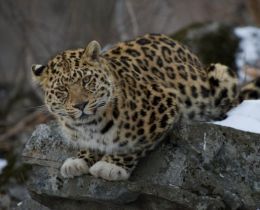
Voir aussi les articles, avec la nouvelle carte de distribution, sur le site du Siberian Times de ce jour.
http://siberiantimes.com/ecology/casestudy/news/were-the-comeback-cats-endangered-amur-leopards-making-a-recovery/
et sur le site du Président de Russie, page publiée ce jour.
http://programmes.putin.kremlin.ru/en/amur_leopard/news/23324

Une bonne nouvelle arrivant rarement seule, les entreprises d'exploitation de bois de TransBaïkalie se sont retirées des plans de coupe de pins de Corée sur le Lac Baïkal comme en extrême orient (WWF Russie, hier).
