

MONADE
UN "LAMANTIN" AU LARGE DES CÔTES DE L'ETAT DE WASHINGTON, ETE 2006...
Ceci fait suite à "Kamtchatka, en toute logique" publié sur ce blog le 30 septembre 2015.
Loren Coleman on September 16th, 2006
Writing in an “A manatee, off our coast?” in the Chinook Observer of Long Beach, Washington State, September 13, 2006, Captain Ron Malast writes:
There have some unusual sightings and catches along the Washington Coast this summer, but none more bizarre than the sighting of a manatee. While trolling for tuna on a course parallel to the Big Dipper, at about 40 miles off the coast, I received a radio call from a skipper of another charter boat. The skipper, for whom I have great respect as a fisherman and a straight shooter, wishes to remain anonymous for fear of being put in a straight-jacket and sent to a loony bin.
He said, “Did you see that? It was a manatee. It was bigger than a sea lion and about 12 feet long. At first I did not know what it was, but we cruised closer to it and I looked it straight in the eye. I then knew exactly what it was, it stayed on the surface for about two minutes, unafraid and then slipped off into the deep. When my brother, who was also on the charter boat, and I got home, we immediately got on the computer and pulled up a picture of a manatee and it was the same mammal that we had seen that afternoon. I will remember it to my dying day for what it was – a manatee.”
Zoologist Bernard Heuvelmans was one of the first to recognize the fact that Steller’s Sea Cow may not be extinct. More recently mainstream scientists, such as marine biologists Bret Weinstein and James Patton of the University of California have noted that there are vague reports of Steller’s Sea Cows from along the northwest coast of North America and the northeast coast of Asia, in the Arctic Ocean and Greenland. If such reports are not discounted, then Hydramalis gigas stelleri, or a subspecies, may still be alive today.


UN ROCHER SUR LA LANDE
LE PASSE N'EST QU'UN PROLOGUE.
Jusqu'aux débuts de la période moderne, des rhinocéros ont peut - être survécu, de la mer d'Azov à celle des Tchouktches. Leur cas peut éclairer la compréhension de l'agencement de la grande faune eurasienne, dans le passé comme dans l'avenir.
Il peut paraïtre étonnant de prime abord, voire surréaliste, d'évoquer le cas de rhinocéros ayant foulé le sol européen à l'époque historique. Pourtant, Planhol (2004) évoque l'existence de « fossiles vivants » dans les steppes pontiques (qui est la région de la mer noire, entre Dniepr et Don). Il envisage sérieusement la survivance tardive, au sein de cet espace, de ce qu'il présente comme « un ou plusieurs descendants du rhinocéros laineux » (Coelodonta antiquitatis, précisé par moi. A.S.) . Il se réfère notamment aux témoignages d'un voyageur arabe du Xème siècle, et d'un voyageur polonais du XVIème siècle.
Lors de son voyage chez les bulgares de la Volga, Ibn Fadlân évoque ce que lui dirent les autochtones à propos d'un animal dont ils lui montrèrent des cornes. Il est, selon eux, moins grand qu'un chameau mais plus qu'un taureau (hauteur au garrot). Sa tête évoque celle d'un chameau, sa queue celle d'un taureau, et son corps rappelle celui d'une mule. Ses sabots ressemblent à celui d'un taureau. Il possède une corne frontale épaisse et arrondie. La longueur de celle – ci se situe entre 1, 50 m et 2, 50 m, selon des observations directes de l'auteur, qui observe aussi des plats réalisés avec la base de ces cornes. Il consomme les feuilles des arbres. Toujours selon les interlocuteurs d'Ibn Fadlân, si l'animal affronte un cavalier, il s'efforce de tuer celui – ci en l'expédiant en l'air et le récupérant sur sa corne, mais il épargne le cheval. L'animal est chassé à l'arc, avec des flèches empoisonnées, par de nombreux tireurs, après avoir été attiré en forêt. Et Ibn Fadlân conclut ainsi : « Des gens de ce pays me dirent que c'était un rhinocéros » (Frye 2005).
Selon Planhol, « on ne peut s'empêcher de faire le rapprochement » avec le témoignage du polonais Martin Broniovius, qui voyage dans le khanat de Crimée, dans la deuxième moitié du XVIème siècle. Celui – ci évoque des « béliers à une seule corne » parmi les animaux qu'un hiver particulièrement rigoureux avait fait périr en nombre dans les steppes d'Otchakov et de Savran (Broniovius 1630, Albrecht et Herdick 2011).
Comment expliquer la présence de ces animaux dans la partie orientale de l'Europe ? Cette question peut être éclaircie par l'existence, au cours du dernier épisode glaciaire, d'une vaste « zone refuge » libre de glace, située entre la boucle occidentale du Fleuve Jaune en Chine jusqu'au bassin du Danube. Cet espace s'est maintenu pour l'essentiel jusqu'à l'époque moderne (XVIIème siècle, voire plus récemment encore) et a peut être permis à certaines populations de résister à la période la plus dure de l'épisode glaciaire et de survivre à l'époque historique. Planhol considère d'ailleurs la steppe pontique comme un « refuge effacé ». Il y relève la présence, aux côtés des rhinocéros, d'antilopes saïgas, d'hémiones (ânes sauvages), de chameaux « de Bactriane » venus avec les pasteurs mongols puis retournés à l'état sauvage (qui parvinrent à se maintenir jusqu'au XVIIIème siècle)* et d'espèces « forestières » comme l'ours ou l'élan, parmi beaucoup d'autres. A cette liste impressionnante d'espèces « asiatiques » et « préhistoriques », il convient d'ajouter le tigre eurosibérien (Heptner 1969, Sennepin 2008a, 2016). Fort logiquement, l'auteur conclut en soulignant qu' « Il n'est pas exclu que l'exploration archéologique de tout cet espace nous réserve encore des surprises ». Ce sujet a d'ailleurs bénéficié récemment d'une illustration spectaculaire. Des scientifiques de l'Université de Tomsk ont découvert que des élans du sud – ouest sibérien étaient en fait des reliques glaciaires (Siberian Times, 9 février 2016).
Par contre, l'affirmation de Planhol selon laquelle il s'agit de rhinocéros laineux paraît pour le moins hasardeuse, pour des raisons à la fois biologiques, écologiques et culturelles. L'animal décrit a en effet une seule corne arrondie, il consomme les feuilles des arbres, un froid excessif le tue. Coelodonta antiquitatis possède deux cornes bien développées. Sa corne frontale est de taille relativement modeste, et sa grande corne nasale possède un côté plat : l'animal peut ainsi évacuer de fortes quantités de neige et parvenir plus facilement à se nourrir de graminées rases et d'armoise. Il peut vivre dans les régions les plus froides de l'Hémisphère Nord, et peut être a t-il survécu pendant des milliers d'années après son extinction officielle dans des zones où le pic d'intensité glaciaire s'est maintenu, voire intensifié jusqu'à nos jours, et qui furent donc un refuge pour lui*** (voir pour le détail de ces différents points : Chernova et Kirillova 2010, Shidlovskyi et collaborateurs 2011).
La description recueillie par Ibn Fadlân correspond en tous points à Elasmotherium sibiricum, un autre rhinocéros « fossile », qui, malgré son nom, vivait dans des zones plus méridionales que C. antiquitatis (Kurten 1968, Zhegallo et collaborateurs 2005).
Et concernant les « béliers à une corne » observés par Broniovius, formulation qui peut laisser dubitatif de prime abord, la reconstitution d'Elasmotherium sibiricum par A.P. Bystrov (Zhegallo et collaborateurs 2005, figure 8, page 25) est, de ce point de vue, spectaculairement éclairante. De plus, la taille, la pilosité, le coloris peuvent varier considérablement dans l'espace et dans le temps chez des animaux du même lignage soumis à des conditions de vie différente (les exemples abondent notamment parmi les grands mammifères terrestres).
Si Coelodonta a particulièrement marqué la culture européenne de l'âge glaciaire (Picard 2003), il ne semble pas avoir laissé de trace importante dans les représentations des civilisations historiques. Il en va tout autrement pour Elasmotherium. Celui – ci est manifestement présent dans les mythologies de nombreuses cultures eurasiennes, dont certaines des plus puissantes et des plus prestigieuses (Zhegallo et collaborateurs 2005)**.
Le célèbrissime chaudron de Gundestrup, forgé au premier siècle avant notre ère, et découvert dans une tourbière du Jutland, au Danemark, compte peut être, parmi ses représentations, celle de la chasse d'un Elasmotherium (scène triple). Du fait de la position des cornes (et de la stylisation des éléphants sur une autre plaque du chaudron), il est en effet douteux qu'il s'agisse d'une tauroctonie ou d'une aurochstonie.
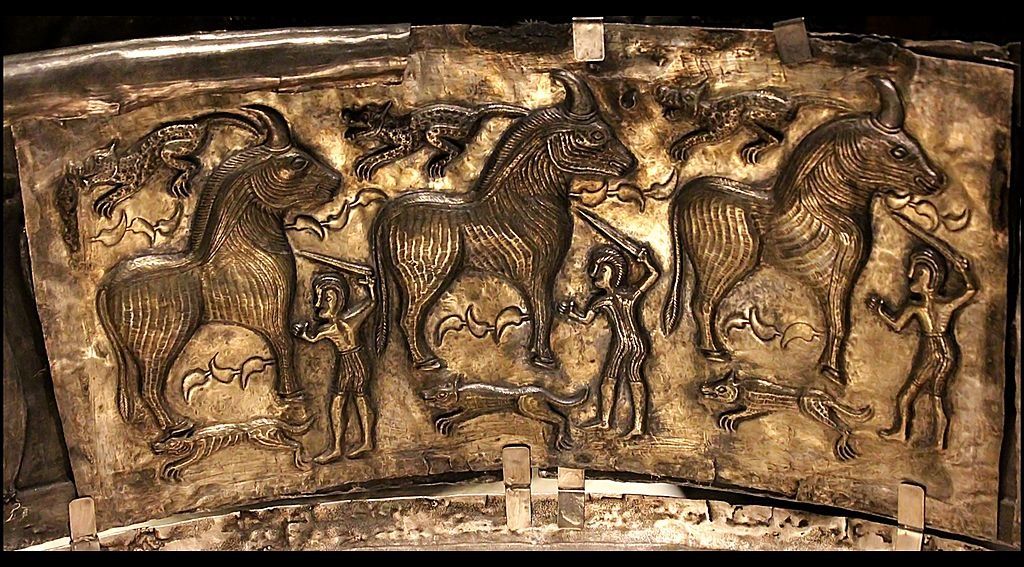
Ceci ne peut être un simple fait du hasard. En effet, s'il y eut forcément des cas de transferts culturels à des sociétés n'ayant jamais été en contact avec le grand rhinocéros unicorne, de nombreuses communautés humaines et cet animal ont vraisemblablement cohabité pendant et après le dernier épisode glaciaire, dans un vaste« refuge » steppique qui les protégeait tous de trop grandes rigueurs climatiques... A ce titre, le « paradoxe yakoute »*** présente un cas très particulier d'une culture porteuse des représentations d' Elasmotherium au sein d'une communauté qui a plutôt cohabité avec Coelodonta...
Au cas précédent, s'ajoute peut être celui de rhinocéros massivement présents en Chine du Nord, jusque sur les côtes du Golfe de Bohaï (Rookmaker 2008), et même dans ce qui est aujourd'hui la Mongolie intérieure (Stephen 1991), jusqu'au IIème millénaire avant notre ère (Rookmaker 2008), et qui, profitant du refuge steppique au cours de la dernière période glaciaire, aurait survécu et même prospéré plus à l'ouest (au moins jusqu'à l'optimum climatique médiéval, entre le Xème et le XIVème siècle) dans des milieux qui restèrent longtemps fort peu anthropisés. Ce rhinocéros européen des temps médiévaux, s'il a jamais existé (nous n'avons pas su trouver trace de lui dans les m>sources éc
INDUCTIONS POUR L'AVENIR. L'affermissement récent de la notion de « refuge écologique » coïncide avec des projets de « renaturalisation » à vaste échelle, dans des espaces peu peuplés ou en dépeuplement (voir par exemple « Rewilding Europe » https://www.rewildingeurope.com/) qui sont et seront les plus sûrs boucliers face aux fluctuations climatiques, tant il est vrai qu'un organisme sain et puissant résiste infiniment mieux aux agressions de toutes sortes qu'un corps décharné et que l'on maintient tel.
En Octobre 2014, Sergeï et Nikolaï Zimov, initiateurs de la steppe à mammouths à la station Tcherskii en Yakoutie (« Pleistocene Park ») ont ouvert un nouvel espace dans la région de Tula, à 250km au Sud de Moscou. Dans une Russie centrale où de nombreux villages sont abandonnés, le retour de grands animaux sauvages s'effectue d'ores et déjà de lui – même (comme, d'ailleurs, plus ou moins discrètement, dans toute l'Europe depuis la deuxième moitié des années 70). Il s'agit désormais d'accompagner ce processus sur le temps long, en étoffant progressivement la diversité d'espèces présentes, pour aboutir sur le long terme à une richesse comparable à celle décrite par Planhol (2004) et avant lui par Berg (1941) sur une très vaste superficie : une « Grande Prairie » russe encadrée par les marais de Polésie à l'ouest ( de Lublin en Pologne à Briansk en Russie en passant par le sud de la Biélorussie et le Nord de l'Ukraine), et ceux de Vassiougan à l'Est, qui ont multiplié leur superficie par 4 au cours des 500 dernières années (Siberian Times, 1er février 2016). Voir pour le détail Sennepin 2014.
Et en Chine, on peut désormais espérer qu'un appétit culturel retrouvé ( Sennepin 2016) débouchera sur un projet de réintroduction du rhinocéros, comme c'est actuellement le cas pour les tigres de Chine du Sud (Save China's tigers : http://savechinastigers.org/).
Enfin, depuis la création de la « Fondation Pleistocene Park » le 9 juillet 2015, la reconstitution du mammouth laineux en Yakoutie dans les décennies à venir n'est plus une simple fantaisie de science - fiction (Lambie 2015), ni même celle, à plus long terme, de Coelodonta antiquitatis*** (Liesowska 2015).
* Leurs derniers représentants (moins d'un millier) vivent aujourd'hui en Chine occidentale et en Mongolie, dans des steppes désertiques au sud et à l'Est des monts Altaï. Les hémiones, saïgas et chameaux n'étaient pas plus « asiatiques » que l'aurochs, l'ours ou l'élan n'étaient « européens ». Tous étaient eurosibériens, même le « bison d'Europe ». De facto, la survie tardive de rhinocéros européens n'est pas plus surprenante que celle de l'âne sauvage d'Europe (Equus hydruntinus), qui vécut dans un espace allant de l'Europe de l'Ouest à la Volga jusqu'aux premiers millénaires de l'Holocene, et qui semble s'être maintenu jusqu'au XVIème siècle dans la steppe espagnole d'Estramadure, sous le nom de « cebro »...
** On ne peut certes pas détailler cet aspect dans le cadre du présent article, l'ampleur considérable d'un tel sujet méritant une publication autonome. En tout état de cause, soulignons ici simplement l'importance, voire la centralité de l'image de l'animal pour la civilisation chinoise (Zhegallo et collaborateurs 2005, Thomas – Parker 2007) et peut être plus encore pour la culture slave ( Zhegallo et collaborateurs 2005, Russell 2009, Sennepin 2015) .
***LE PARADOXE YAKOUTE. L'épopée yakoute Olonkho évoque un « taureau de l'hiver » énorme, doté d'une gigantesque corne frontale, et d'une fourrure bleutée. Ce peuple est originaire de la région du Baïkal (Zhegallo et collaborateurs 2005), de culture mongole, dans laquelle la couleur bleue a une grande importance. Région la plus continentale de la planète, elle connaît un régime atmosphérique particulier, où les jours de ciel d'azur dans l'année sont les plus nombreux au monde. Par ailleurs, le bleu et le blanc sont perçus comme symboliquement homologues (la horde gengiskhanide basée dans le sud du Kazakhstan actuel était indifféremment qualifiée de « bleue » ou « blanche »). Les vicissitudes de l'Histoire ont poussé ce peuple à migrer dans une région beaucoup plus septentrionale, aux conditions de vie beaucoup plus dures mais qui les mettait à l'abri de leurs ennemis. Ils y ont vraisemblablement importé leur mythologie originelle (Zhegallo et collaborateurs 2005). Gavril Ksenofontof, au XIXème siècle, collecta en Yakoutie de nombreuses légendes sur des taureaux unicornes, à la fourrure de couleurs variées. Et en 1866, Vasily Radlov recueillit la légende d'un « immense taureau noir » tué à la lance, qui possédait une corne unique si grande qu'elle devait être transportée sur un traîneau.En 1878, A.F. Brandt suggéra qu'il s'agissait d'un Elasmotherium (Kurten 1971, Zhegallo et collaborateurs 2005). Or, si cette hypothèse est compatible avec l'espace mongol, elle l'est beaucoup moins pour la Sibérie du Nord - Est, le grand rhinocéros unicorne ayant une distribution plus méridionale. Et pourtant, l'image de l'Elasmotherium dans la culture yakoute est, aujourd'hui encore, plus vivace que partout ailleurs dans le monde. Dans ce même espace, les cornes de Coelodonta antiquitatis, extrêmement abondantes, sont à la base, depuis des millénaires, de l'industrie traditionnelle locale (lances, arcs...). Au même titre que les défenses de mammouths laineux, le « stock » paraît inépuisable... De plus, la corne nasale de Coelodonta atteint parfois des proportions gigantesques, comparables à celle de l'immense corne frontale d'Elasmotherium. Il est donc plausible que des communautés yakoutes aient intégré ces cornes à leur mythologie originelle, en sus de leur économie factuelle. Et peut être même ont -ils été confrontés à l'animal lui - même. En effet, particulièrement répulsif pour Elasmotherium et tant d'autres espèces, le nord du territoire, et particulièrement le bassin de la rivière Yana, endroit le plus froid de l'Hémisphère Nord, a manifestement constitué un refuge pour C. antiquitatis, où ses restes sont les plus abondants (Shidlovskyi et collaborateurs 2011). Une pointe de lance de 90cm taillée dans sa corne a été découverte sur une île arctique, 380km plus au Nord (Siberian Times, 30 septembre 2014). Celle - ci servait probablement à combattre les rhinocéros eux mêmes (légende recueillie par V. Radlov déjà citée) et des félins géants (tigres ou lions des cavernes, Prynn 2004). On ne peut donc exclure que cet animal se soit maintenu jusqu'à une époque relativement récente dans ce sanctuaire où l'âge glaciaire a perduré jusqu'à nos jours. Dans ces conditions, pour des communautés où l'image d'Elasmotherium est importante, il est facile d'imaginer l'impression (et les conséquences culturelles de celle - ci) que peut produire l'apparition, dans le blizzard, d'un géant cornu recouvert de neige et accompagné du tintement des glaçons attachés à son pelage... Sans parler du cas individuel du rhinocéros à fourrure blanche (comme il y a des bisons blancs, objets d'un culte particulier en Amérique du Nord). Aujourd'hui, comme les russes vis - à - vis du tigre (Sennepin 2016) les yakoutes sont plus que jamais passionnés par leur patrimoine archéologique et paléontologique, et même l'espoir de voir revivre, un jour, celui - ci . Ces dernières années, d'impressionnantes découvertes d'animaux dans un état de préservation remarquable, ont eu un vaste écho : le mammouth laineux, dont on envisage désormais sérieusement la reconstruction génétique et la renaissance, à l'aide d'une mère porteuse éléphante d'Asie (Lambie 2015), mais aussi un très jeune rhinocéros laineux (Liesowska 2015), et deux lionceaux des cavernes (Koryakina 2015). Ceci coïncide avec la naissance de la Fondation Pleistocene Park. Solidement appuyée sur ses fondations anthropologiques, la culture yakoute se redéploie sous nos yeux.
Actualisation au 5 mai 2017. Voir aussi, sur LE PARADOXE YAKOUTE. Publié au printemps 2017 chez Odile Jacob. Crubézy (E), Nikolaeva (D). Vainqueurs ou vaincus? L'énigme de la Iakoutie. L'ouvrage établit le caractère historiquement insubmersible de la culture yakoute, et que toute société a le pouvoir d'écrire son avenir.
BIBLIOGRAPHIE
Albrecht (S), Herdick (M). 2011. Im Auftrag des Königs : ein Gesandtenbericht aus dem Land der Krimtataren : Die Tatariae Descriptio des Martinus Broniovius (1579). Regensburg.
Berg (L). 1941. Les régions naturelles de l'URSS. Traduction française par G. Welter. Bibliothèque Payot, Paris.
Broniovius (M). 1630. Martini Broniovii de Biezdzfedea, ad tartarum Legati, Tartaria. Dans Russia seu Moscovia itemque Tartaria, Leyde (ex officina Elzeviriana).
Chernova (O. F), Kirillova (I. V) 2010. New data on horn morphology of the woolly rhinoceros (Coelodonta antiquitatis Blumenbach, 1799). Proceedings of the Zoological Institute 314, 333-342. Fry (R). 2005. Traduction anglaise du texte d'Ibn Fadlân.. Ibn Fadlan’s journey to Russia. A tenth century traveller from Baghdad to the Volga River. Princeton. Markus Wiener Publishers.
Heptner (V.G). 1969. O lyutom zvere Monomakhova "Poucheniya detyam". Okhota i Okhotn. Khoz., 5, 42 – 43.
Koryakina (A). 2015. WORLD EXCLUSIVE. Meet this extinct cave lion, at least 10 000 YEARS OLD. Siberian Times, 26 octobre 2015.
Kurten (B). 1968. Pleistocene Mammals of Europe. London: Weidenfeld and Nicolson .
Kurten (B). 1971. The Age of Mammals. London: Weidenfield and Nicolson.
Lambie (D). 2015. Mammoth could be brought back to life in siberian reserve. Siberian Times, 5 mai 2015.
http://siberiantimes.com/science/casestudy/news/n0207-mammoth-could-be-brought-back-to-life-in-siberian-reserve/
Liesowska (A). 2015. Sacha, the world's only baby woolly rhino, is 34000 years old, say scientists. Siberian Times, 8 septembre 2015.
http://siberiantimes.com/science/casestudy/news/n0393-sasha-the-worlds-only-baby-woolly-rhino-is-34000-years-old-say-scientists/
Orlando (L), Leonard (J.A), Th
Picard (J.J). 2003. Le mythe fondateur de Lascaux. Editions de l’Harmattan.
Planhol (X.de). 2004. Le paysage animal. L’Homme et la Grande Faune : une zoogéographie historique. Editions Fayard.
Prynn (D). 2004. Amur Tiger. Russian Nature Press.
Rookmaker (K). 2008. Distribution et extinction des Rhinocéros en Chine (Traduction : Henri Carpentier). La Lettre de la SECAS 53, page 11.
Russell (J.R). 2009. From zoroastrian Cosmology and Armenian Heresiology to Russian Novel, 141 – 208, in : Allison (A), Joristen – Pruschke (A), Wentland (A). From Daëna to Dîn : Religion, Kultur und Sprache in der iranischen Welt. Festschrift für Philip Kezenbroek zum 60. Geburtstag. Wiesbaden : Harassowitz.
Sennepin (A). 2008a. Un tigre européen oublié. La Lettre de la SECAS 52, janvier 2008, 20 – 22.
Sennepin (2008b). L'Empire du million de tigres. La Lettre de la SECAS 54, page 26.
Sennepin (A). 2014. 13 décembre. Une grande prairie en Russie centrale. Blog « Retour du tigre en Europe ».
http://europe-tigre.over-blog.com/2014/12/une-grande-prairie-en-russie-centrale.html
Sennepin (A). 2015. 30 mars. Profondeur, profusion. Blog « Retour du tigre en Europe ».
http://europe-tigre.over-blog.com/2015/03/profondeur-profusion.html
Sennepin (A). 2016. 2015 : Le Tigre du Nord, fer de lance de l'Avenir. La Lettre de la SECAS 83, février 2016, 4 – 8.
Shidlovskiy (F.K), Kirillova (I.V), Wood (J). 2011. Horns of the woolly rhinoceros Coelodonta antiquitatis(Blumenbach, 1799) in the Ice Age Museum collection (Moscow, Russia). Quaternary International 255, 125 – 129.
Siberian Times. 30 septembre 2014. 13 300 year old spear made of woolly rhinoceros horn found on Arctic island.
http://siberiantimes.com/science/others/features/13300-year-old-spear-made-of-woolly-rhinoceros-horn-found-on-arctic-island/
Siberian Times. 1er février 2016. Special status for swamp that saves the world.
http://siberiantimes.com/ecology/casestudy/features/f0207-special-status-for-swamp-that-saves-the-world/
Siberian Times. 9 février 2016.This moose is a lot older than you think.
http://siberiantimes.com/science/casestudy/news/n0580-this-moose-is-a-lot-older-than-you-think/
Stephen (B). 1991. The bow – shaped bronze fitting and its context in Shang China. Pages 186 – 187, dans : Ching (J), Guisso (R.W.L). Sages and filial sons : Mythology and Archaeology in ancient China. Chines University Press.
Thomas Parker (J). 2007. The mythic chinese unicorn.
Zhegallo (V), Kalandadze (N), Shapovalov (A),

LE REGARD
CHINE, LE VERITABLE ETIAGE. Ceci est un complément à "INVICTUS", publié sur ce blog le 17 février (il y a 9 jours).
Hans et mandchous, regards croisés. Kang (A) et ses collaborateurs ont publié en 2010 une revue très intéressante de milliers de mentions du tigre en Chine au cours de 2000 dernières années. Historic distribution and recent loss of tigers in China. Integrative Zoology 5, 335 - 341
Article directement accessible en format PDF à cette adresse : http://onlinelibrary.wiley.com/doi/10.1111/j.1749-4877.2010.00221.x
Les tigres sont présents partout, et ce à un niveau de densité phénoménale dans le centre et le sud du pays. Or, la plupart des observations à ce sujet sont postérieures à 1644, ce qui semble induire que ce sont les mandchous qui ont massivement recensé les tigres méridionaux et centraux, parce que ces animaux les intéressaient tout particulièrement, puissamm entntégrés à leur culture dans le Nord de très longue date, et qu'ils furent sidérés d'une telle profusion méridionale.
Les quatre principales cultures Hans cohabitaient avec ces félins depuis des millénaires, sur des bases culturelles beaucoup plus liées à la pharmacopée (des traités de tigrologie étaient rédigés sur l'animal, l'un des plus célèbres et des plus volumineux remontant au XVIème siècle, rédigé par Che Ki Ju, d'autres ont vu le jour à la fin du siècle dernier - Li Quan, communication personnelle du 23 juin 2007-).
Par contre, peu d'observations concernent la Chine occidentale ("le Turkestan chinois") qui fut conquise aux dépens des populations nomades mongoles, kazakhes et turkmènes au cours du XVIIIème siècle, qui représente plus de la moitié de l'espace chinois d'aujourd'hui et où vivaient des tigres eurosibériens...
Les Hans de l'Antiquité furent beaucoup plus attentifs aux différents rhinocéros présents à profusion sur leur territoire (et pas seulement, tant s'en faut, pour l'usage de leurs cornes) :
Thomas Parker (J). 2007. The mythic chinese unicorn.
Rookmaker (K). 2008. Distribution et extinction des Rhinocéros en Chine (Traduction : Henri Carpentier). La Lettre de la SECAS 53, page 11.
LE PAYS DES MAREES. Royaume du million de rhinocéros pour les uns, puis du million de tigres pour les autres, la Chine est aujourd'hui "à marée basse faunistique". Le processus actuel de reconstruction progressive de sa culture du grand félin peut s'étendre demain à celle du grand ongulé périssodactyle.
Toute culture, comme tout organisme, est une chimère de récapitulation.
NEW DEHLI, AVRIL 2016
APRES ST PETERSBOURG, NOVEMBRE 2010
Un Sommet international sur le tigre, après celui de 2010 à St Petersbourg et avant celui de 2022, se tiendra en Inde du 12 au 14 Avril prochain. Times of India, hier. Vishwa Mohan. India to host a mega conference to brainstrorm on tiger conservation.
http://timesofindia.indiatimes.com/home/environment/flora-fauna/India-to-host-a-mega-conference-to-brainstorm-on-tiger-conservation-in-April/articleshow/51110941.cms
India, home to nearly 70% of the world's tiger population, will host the next Asia Ministerial Conference on tiger conservation. The three-day conference will be inaugurated by the Prime Minister Narendra Modi here on April 12.
All tiger range countries (TRCs) will participate in the conference where their representatives would share their good practices and success stories towards conserving tigers. The gathering is expected to bring desired will and momentum for tiger conservation at global level.
According to the 2014 tiger census, India has 2,226 tigers with the three southern states of Karnataka, Tamil Nadu and Kerala of the Western Ghats landscape recording nearly one-third of the country's total number of big cats.
Final schedule of holding the 3rd Asia Ministerial Conference was decided on Monday in a meeting which was attended here by representatives of five TRCs - India, Bhutan, Indonesia, Malaysia and Russia.
During the meeting, chaired by the India's environment and forest minister Prakash Javadekar, the participants highlighted how poaching is the biggest threat to tigers across all the 13 TRCs. They noted that the existing market, backed by huge demand for tiger body parts and derivatives in different countries, is the main reason of poaching and therefore there is a need for sustained effort from all Tiger Range Countries and other partners outside the government system to conserve the big cats.
India has, however, over the years recorded increase in its tiger population. If one compares the year 2006 figure, the overall increase across the country has been phenomenal with recording rise of over 800 tigers in the past eight years. The country had 1,411 tigers in 2006 which was increased to 1,706 in 2010 and 2,226 in 2014.
State-wise, Karnatakas has the highest number of tigers (406) followed by 340 in Uttarakhand, 308 in Madhya Pradesh, 229 in Tamil Nadu, 190 in Maharashtra, 167 in Assam, 136 in Kerala and 117 in Uttar Pradesh.
DERNIER DOMICILE CONNU
Les mammouths dont les restes ont été retrouvés sur le site de Vochya Griva, MAMONTOVOYE, étaient tous de jeunes ou très jeunes individus, qui avaient parcouru des centaines de kilomètres pour se reminéraliser par géophagie, comme le font les éléphants. Ils souffraient d'ostéoporose, probablement consécutive à une alimentation carencée liée aux changements intervenus dans les faciès végétaux. Cet endroit constitue le refuge le plus méridional de l'espèce actuellement répertorié. Il est aussi le plus récent (en tout cas sur le continent, les mammouths nains de l'île Wrangel ayant été contemporains des pharaons égyptiens...). Siberian Times, ce jour. Olga Gertcyk. Paleolithic man "not the main cause of deaths at vast mammoth graveyard".
http://siberiantimes.com/science/casestudy/features/f0214-paleothithic-man-not-the-main-cause-of-deaths-at-vast-mammoth-graveyard/
POSSIBILITE D'UNE ÎLE

L'Indonésie prépare t-elle un centre de reproduction pour des tigres de Sumatra sur une de ses îles périphériques? La reproduction de cet animal en captivité s'améliore. Celui - ci tend à se séparer génétiquement des sous espèces continentales, et il s'agit ici de protéger une espèce à part entière à venir, alors que la situation du sud du continent asiatique continue à se dégrader (présence relictuelle en Birmanie, Cambodge, Laos, Vietnam, simple maintien en Thaïlande et continuation de l'effritement en Malaisie). Jakarta Post, ce jour. Apriadi Gunawan. Medan zoo applauded after birth of Sumatran tiger.
http://www.thejakartapost.com/news/2016/02/22/medan-zoo-applauded-after-birth-sumatran-tiger.html
Medan Zoo in North Sumatra has earned plaudits for its good management of an endangered species after a healthy Sumatran tiger cub was born at the zoo.
Zoo operational director Sunardi Ali said the cub was born on Friday to a tiger pair named Manis and Anhar.
Sunardi said the management was limiting the number of visitors allowed to see the newborn, giving Manis more time to nurse her cub.
“We’ve left the baby and its mother in the cage. The mother is clearly very protective of the baby,” Sunardi told The Jakarta Post on Sunday.
As a result of the mother’s fierce protectiveness, the zoo management, he said, was as yet unable to determine the sex of the cub, which had an estimated weight of 2.3 kilograms and length of 30 centimeters.
Eighteen-year-old Manis has previously given birth to three other cubs fathered by her mate Anhar, Sunardi said.
“This is the fourth baby. All the Sumatran tigers born here have grown up healthy,” he said.
He added that the management planned to name the baby tiger Benar, a contraction of Bang Eldin and Akhyar, the names of the newly elected Medan mayor and deputy mayor.
With the birth of the cub, Sunardi said there were now 10 Sumatran tigers at the zoo.
“Hopefully that number will continue to grow, and we can increase our collection of Sumatran tigers.”
In November last year, four male Bengal tigers were born at the zoo, taking the total to six.
The Switzerland-based International Union for Conservation of Nature (IUCN) has listed the Sumatran tiger as a critically endangered species since 1996.
The organization reported that the species had been struggling with habitat loss amid the expansion of oil palm and acacia plantations, as well as illegal trading, primarily for the domestic market.
Separately, Indonesian Zoos Association chairman Rahmat Shah welcomed the news, describing it as proof of the zoo’s ability to treat animals properly.
“It shows endangered animals are well treated by the zoo. We are very pleased,” Rahmat said, adding that Sumatran tigers could, if treated properly, give birth every year.
Rahmat’s comments appeared to refer to a string of animal deaths, including tigers, at Surabaya Zoo in East Java, reportedly as a result of mismanagement.
At the time, Rahmat said that the deaths had tarnished the image of the nation.
Six animals died at Surabaya Zoo in January and February 2014. A Komodo dragon and a Bawean deer both died on Feb. 1.
Earlier, a 4-year-old male gnu, or wildebeest, was found dead on Jan. 4. Based on necropsy results, the African animal died of stomach disease.
The following week, on Jan. 7, a lion named Michael was found dead hanging from a steel cable in his cage. A 6-month-old mountain goat was then killed in a fight with a larger mountain goat.
On Feb. 5, a Bengal white tiger named Chandrika died while undergoing treatment.
Surabaya Mayor Tri Rismaharini subsequently filed a report with the Corruption Eradication Commission (KPK) accusing the former management of Surabaya Zoo of graft and gross mismanagement resulting in the deaths of the animals.
Risma alleged there were groups within the management that had traded animals in return for financial gain, sparking internal conflicts.
Rahmat, who also manages Pematang Siantar Animal Park in North Sumatra, underlined the important role of government in preserving the Sumatran tiger.
“The government, for example, could provide a special place in one of the country’s outer islands to breed the species,” he said. - See more at: http://www.thejakartapost.com/news/2016/02/22/medan-zoo-applauded-after-birth-sumatran-tiger.html#sthash.J7gJMF12.dpuf
LE TIGRE ET LE DROIT
Lors d'une table ronde qui s'est tenue le 16 février, la décision a été prise d'une publication, au printemps qui vient, d'un manuel juridique spécialement dédié au tigre, pour la première fois au monde. Celui - ci englobera de nombreux aspects concernant sa protection, dont les questions cruciales sur son milieu et ses proies. Amur Tiger Centre, hier.
В МОСКВЕ ЭКСПЕРТЫ ОБСУДИЛИ ОПЫТ РАССЛЕДОВАНИЯ ПРЕСТУПЛЕНИЙ ПО ДОБЫЧЕ АМУРСКОГО ТИГРА
ATTENTION AUX CHIENS
En Corée, pendant l'occupation japonaise, les loups laineux (Canis lupus chanco, considérés par la communauté scientifique comme les ancêtres les plus probables des chiens domestiques) provoquèrent plus de pertes humaines que les tigres, léopards, ours et sangliers réunis. EN 1928, ils en provoquèrent 6 fois plus... OhmyNews International Korea, 23 Mai 2007. Robert Neff. Devils in the Darkness.
Life in Korea prior to modernization was often short-lived. Diseases, accidents, and wild animal attacks were common. With so much of Korea covered in mountainous wilderness and forests, especially in the northern part of the peninsula, attacks by wild animals were common. Surprisingly, tigers were not the most dangerous animals to the Koreans, especially children: it was the gray wolves that claimed this dubious honor.
Gray wolves once roamed the wilds of the northern, central and parts of the southern Korean Peninsula in small packs. They mainly inhabited deep forests and sparsely wooded lands, but would hunt the fields and pastures of Korean farmers when food became scarce and hunting the domesticated animals of the farmer, or even the farmer and his family, was easier -- especially during the winter
A look back at the newspapers from the past reveal just how extensive wolf attacks upon humans were. According to the Japanese Police Bureau in Korea, in 1928 28 Koreans were killed and 53 three were seriously wounded by wild animals, with most of the attacks done by the top-five predators.
Predator................Human Victims.................Cattle Lost
Tiger...........................1.......................................103
Leopards....................3.......................................272
Bears.........................0.........................................26
Wolves.....................48.....................................3,396
Boars..........................4........................................33
Having researched the Western mining concessions in Korea (1897-1939), I am keenly aware of just how much the wolf figured into the lives of the miners. Although wolves were a part of everyone's lives at the mining communities, it was the children of these miners that remember them the most vividly in their writings -- perhaps because they were all too aware of their place on the wolves' food chain.
Charles John Pedersen, a great chemist and Nobel Prize winner, was born in Busan in 1904. His father was a Norwegian named Brede who first came to Korea as part of the crew of a steamship that the Korean government had purchased from Europe. Brede eventually gave up the life of a seaman when his first son died while he was at sea and instead took up the life of a miner -- first at the Oriental Consolidated Mining Company [OCMC] and then later at the French Concession at Taiyudong. For most of Charles's life he lived in Japan and the United States, but he did spend one year at the OCMC's mines at Unsan in 1908. He recalled his year spent at the mines and the animals that dwelt within the wilderness that surrounded them:
James Blain, a son of a miner from Indiana, remembered that the wolves often came down from the surrounding hills and mountains, and occasionally attacked small children. In Pukchin village, the largest Korean community on the OCMC's concession, James knew a small child that was taken and another little boy who lost his ear to wolves.
Despite the danger, one evening in the early 1920s, when James was about seven or eight, he and another little boy went for a walk in the hills surrounding the mines. Even though they knew that wolves attacked children, they were not afraid. James later explained to his worried parents that he and his playmate knew wolves did not like fire, and, because they carried a torch, knew they were safe.
His younger brother, John, was not as confident and brave when it came to wolves. When he was in Korea nearly ten years later, the wolves were just as bad, if not worse.
Wolves continued to plague the Korean countryside long after the tigers became scarce, and for the most part extinct, moving to the top of the food chain. Farmers and rangers, both Korean and Japanese alike, hunted and trapped the wolves extensively not only for their pelts but also as protection for their families and livestock. Despite their best efforts, the wolves continued to flourish.
It would be interesting to know how the wolves fared during the Korean War when so much of the country was destroyed and food more plentiful (in the form of corpses and animal carcasses), and the people better armed. Evidently the wolves were so plentiful in North Korea that in 1959 the North Korean government designated the wolves as nuisances and granted permission for any citizen to hunt them at will. According to surveys performed in the 1980s there were an estimated to be no more than 20 wolves in the Mount Paekdu region, but with the great famines and disasters that plagued the North in the late 1990s and the early 2000s, the continued existence of these wolves is uncertain.
Wolves in South Korea fared even worse. With most of the country rapidly being developed and forested and uninhabited lands few, by the early 1960s the Gray Wolf was all but exterminated from South Korea -- with perhaps only a few left in the mountainous regions of Chiri-san and Taebaek-san. There have been reported sightings, the most recent in 1987, but no concrete proof of the wolf's continued existence in the wilds of South Korea.
There have been efforts to save the Korean Gray Wolf from extinction. Some of them have been extreme and highly controversial. In 2005, a team at Seoul National University (SNU) claimed to have cloned two Gray wolves -- named Snuwolf and Snuwolffy -- but this claim has come under the scrutiny of the scientific community and the paper has been withdrawn. The Scientist magazine quoted Robert Lanza, the medical director at Advanced Cell Technology, as saying, "No peer reviewed journal would [remove a paper from its Web site] unless there was a major concern."
Despite their great numbers in the past, the wolves have literally disappeared in the 60-plus years since the Western gold miners left Korea. They, like the tigers, are now stories from the past -- a treasure that has been lost.
ALEOUTES EQUILIBRATEURS
Cet article est une suite à "La Condition humaine", page publiée sur ce blog le 13 avril dernier, et à "Kamtchatka, en toute logique" publié le 30 septembre.
LES PRATIQUES DES PECHEURS ALEOUTES ENRICHISSAIENT LEUR ENVIRONNEMENT ET FAVORISAIENT LEURS ESPECES PROIES. Etude parue dans NATURE il y a deux jours.
A new study of humans on Sanak Island, Alaska and their historical relationships with local species suggests that despite being super-generalist predators, the food gathering behaviors of the local Aleut people were stabilizing for the ecosystem.
The findings provide insights into how human roles and behavior impact complex ecological networks and offer new quantitative tools for studying sustainability.
With a team of ecologists and archeologists, the Santa Fe Institute's Vice President for Science Jennifer Dunne wanted to understand the niche humans filled in Sanak's marine ecosystems by compiling and analyzing local food web data.
"It's the first highly detailed ecological network data to include humans, which allows us to ask questions about how they compare in their roles to other predators," says Dunne. "Unlike most ecological studies that ignore humans or consider them as external actors, our analysis includes them as an integral part of the ecosystem."
For roughly 7,000 years, the Sanak Aleuts hunted marine mammals and fishes in the nearby open water and gathered shellfish and algae closer to shore. Dunne and her colleagues put together a precise picture of the local marine food webs by studying the bones and shells left behind in middens (trash heaps), through oral histories gathered from Aleut elders, and ecological data.
Then, through analysis of the network structure of these food webs, they discovered that in both the intertidal and nearshore food webs, humans fed on approximately a quarter of the species present, far more than other predators in the systems. This varied diet, ranging from primary producers like algae to top carnivores like sea lions, puts humans in a niche similar to other super-generalist predators like Pacific cod.
And, like other generalists, the Aleuts prey-switched. As a favored prey species became difficult to find due to population decreases or unfavorable environmental conditions, the Aleuts chose alternative food sources. In food webs where predators prey-switch, dwindling prey populations can bounce back and extinctions are rare.
"It's a very stabilizing behavior for the system," says Dunne.
In addition, while simple technologies like fish hooks, spears, and kayaks helped the Aleut hunt some of their prey more intensively than expected for non-human predators, Dunne's analysis of the dynamics of model food webs suggests that as long as such intensive hunting was limited to a few prey species, it would cause few extinctions.
Modern fisheries can put a very different pressure on food webs, she notes. Advanced technology allows for highly intensive fishing, and in many cases as a resource becomes scarce, its value goes up. In these cases, such as with Bluefin tuna that are a highly prized sushi fish, "increased rarity increases economic value, leading to increased harvesting pressure at just the wrong time," says Dunne. "You're not only driving those populations to extinction, you're also introducing a destabilizing dynamic into the system."
The paper appeared February 17 in Nature Scientific Reports.
Story Source:
The above post is reprinted from materials provided by Santa Fe Institute. Note: Materials may be edited for content and length.
Journal Reference:
Jennifer A. Dunne, Herbert Maschner, Matthew W. Betts, Nancy Huntly, Roly Russell, Richard J. Williams, Spencer A. Wood. The roles and impacts of human hunter-gatherers in North Pacific marine food webs. Scientific Reports, 2016; 6
L'HOMME MODERNE
Les hommes modernes avaient quitté l'Afrique au moins 35 000 ans avant l'époque établie jusqu'alors par la communauté scientifique. Ils se sont reproduits avec des Neanderthaliens en Eurasie il y a 100 000 ans (preuves découvertes dans la grotte Denisova, dans l'Altaï, au Sud Ouest de la Sibérie. Siberian Times, ce jour. "denisova cave reveals sex between modern humans and Neanderthals 100 000 years ago."
http://siberiantimes.com/science/casestudy/news/n0588-denisova-cave-reveals-sex-between-modern-humans-and-neanderthals-100000-years-ago/
